Feel Lifted
Looking to microdose and macrodose to improve your mood? Get started with this bundle. .

Psychedelic therapy pairs a supervised dose of a psychedelic medicine, most often psilocybin or MDMA, with structured psychotherapy before and after. The medicine is not the whole treatment. The preparation, the monitored session and the follow-up conversations are what turn a few hours of altered consciousness into something a person can use in daily life. If you are curious about mental clarity, emotional balance or creative renewal, understanding this model helps you read the research clearly and ask better questions about your own path.
The College of Family Physicians of Canada describes psychedelic-assisted psychotherapy as structured psychotherapy combined with the supervised administration of a psychedelic medicine in a controlled setting. It rests on the idea of “set and setting”: your mindset going in, and the physical and human environment around you during the session.
The same source is clear about where it sits in the health system. It is not a first-line treatment, and it is not something delivered in routine primary care. It involves thorough medical and psychiatric screening, informed consent, preparatory education, a monitored session with trained therapists present, and follow-up psychotherapy.
That distinction matters for you as a reader. Taking a substance on its own and going through a therapy protocol are different experiences. Research results come from the second, and they depend on the structure around the dose.
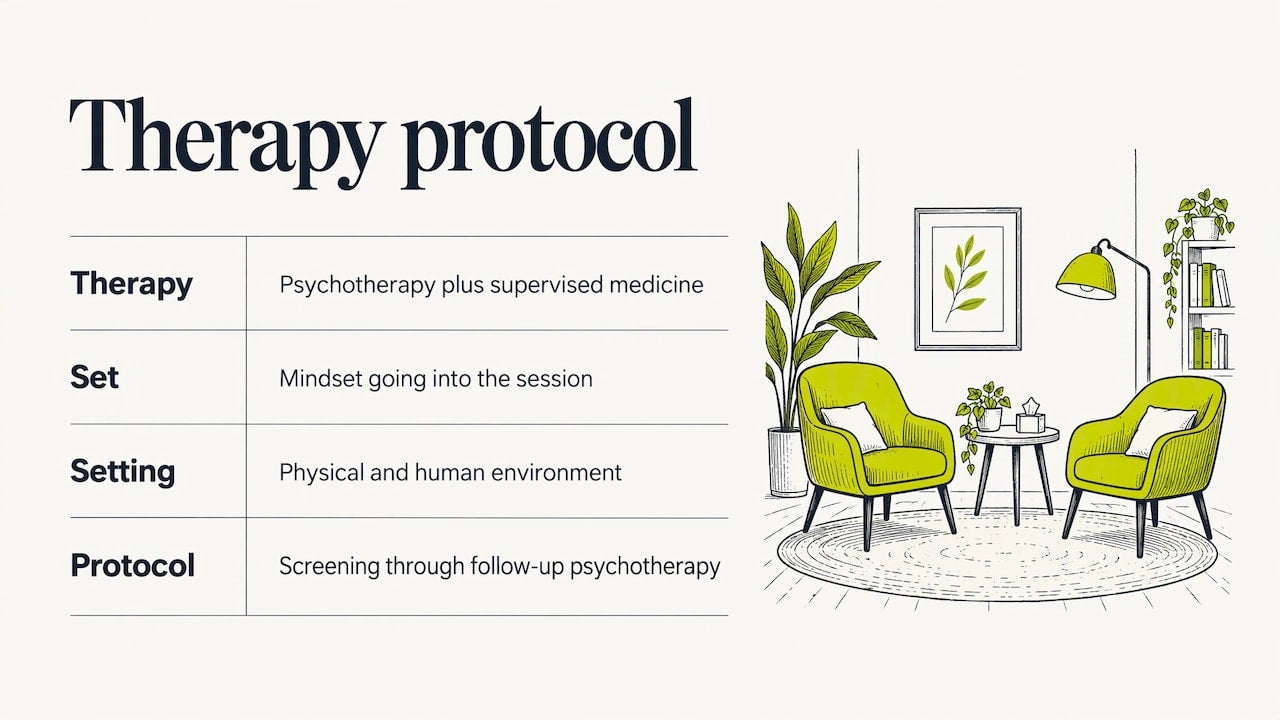
The College of Family Physicians of Canada outlines three phases. Each one has a job.
Preparation usually takes several sessions. It includes medical and psychiatric screening, informed consent and education about what the experience can feel like. Just as importantly, you and your therapists build rapport and clarify your intentions. Going in with a question, such as “what keeps me stuck in this pattern?”, gives the session a direction.
You receive a controlled dose in a monitored clinical setting. Trained therapists are present for psychological support and to watch your physical safety. Sessions typically last several hours, and the point is to stay with whatever arises rather than steer it.
The Ontario regulator for psychotherapists, the CRPO, sets a firm standard: psychedelics are never to be administered without a medical professional on site for screening, informed consent and emergency intervention, and the participant is medically monitored throughout by someone with authority to prescribe and dispense medication in an emergency.
Integration is where the experience becomes useful. In follow-up sessions you consolidate insights, work through the emotions that surfaced and translate them into lasting behavioural and psychological change. Many people find this the longest phase. A striking moment during the session does little unless it connects to habits, relationships and decisions afterwards.
Nobody has a complete answer yet. A 2026 BMJ review says psychedelics appear to act through several biological and psychological pathways at once: neural circuitry, emotional processing and psychological flexibility. These are not fully understood.
In plain terms, the working theory is that a psychedelic loosens rigid patterns of thought for a few hours, and therapy uses that window to look at old stories differently. If you want the biology side in more depth, our summary of psilocybin and neuroplasticity walks through what researchers have observed.
The BMJ authors also note that newer ideas, such as group administration, may widen access, but how well they work compared with one-to-one therapy remains to be established.
Not every psychedelic is studied for the same purpose. CAMH, Canada’s largest mental health teaching hospital, lists promising research by substance:
| Substance | Conditions with promising research |
|---|---|
| Psilocybin | End-of-life distress, depressive disorders, PTSD, some substance use disorders |
| MDMA | PTSD |
| LSD | Some substance use disorders, generalized anxiety disorder |
| Ketamine | Treatment-resistant depression, PTSD, some substance use disorders, anxiety disorders |
The College of Family Physicians of Canada says psilocybin and MDMA have the most robust evidence. It reports 28 registered Canadian psilocybin trials under way, a pooled depression remission rate of 45% with psilocybin against 22% in comparison groups, and a large effect for MDMA in PTSD (Hedges g of 1.24 versus placebo; Hedges g is a standard measure of how big a treatment effect is). The same page notes that two phase 3 psilocybin trials for treatment-resistant depression have reported positive results, pending full peer-reviewed publication.
The BMJ review agrees that psilocybin for treatment-resistant depression and MDMA for PTSD have the strongest support, with emerging data in substance use disorders and distress in life-threatening illness. It adds that these treatments are well tolerated under controlled conditions, while trial design questions, such as participants guessing which arm they are in and varying therapy protocols, make results harder to interpret.
If one of these conditions is your focus, we have separate pages on psilocybin and addiction, psilocybin for grief, PTSD and end-of-life distress.
Clinical psychedelic therapy uses full doses in a supervised session. Microdosing is a different practice: very small, regular amounts intended to sit below a noticeable effect. CAMH describes microdosing research as mixed so far, and it is a younger field than the clinical work above. Readers interested in focus, mood and creativity most often come to the topic through microdosing, which is why we publish guidance on responsible use alongside our products.
Screening exists because psychedelics affect the heart, the mind and the way other medications behave. The College of Family Physicians of Canada lists common adverse events as tachycardia (fast heartbeat), raised blood pressure, nausea, headache, anxiety and dissociation. They are typically mild and short-lived. Suicidal thoughts or behaviour have been documented only infrequently as serious events.
The groups that need particular care are well defined. The Alberta College of Psychologists lists these medical contraindications in its June 2025 guideline:
Its psychiatric contraindications include schizophrenia, schizoaffective or bipolar disorder, current mania, significant trauma histories without coping skills, and recent suicidal thoughts. The College of Family Physicians of Canada also flags a personal or first-degree family history of psychotic disorders, bipolar disorder or borderline personality disorder.
Health Canada adds that a difficult experience can bring paranoia and impaired judgement, that risk rises when psilocybin is combined with cannabis, amphetamines or alcohol, and that people with heart disease can be affected by increased blood pressure and heart rate. If any of this applies to you, talk to your physician or psychiatrist before going further.
CAMH also points out that people in psychedelic therapy can be vulnerable, which is why oversight of therapists matters. The CRPO notes that registered psychotherapists cannot independently manage medical events, so a proper support team is required, and a medical professional may take part in integration sessions to check for medical effects.
The team behind a legitimate programme has several roles. A physician or psychiatrist handles diagnosis and prescribing. Psychotherapists or psychologists provide the talk-therapy work. The Alberta College of Psychologists requires psychologists in this field to have at least five years of experience with stress, mood or related disorders using evidence-based psychotherapy, and to work in collaboration with a prescribing physician or psychiatrist, since prescribing and diagnosing sit outside psychological practice.
When you hear about a programme, these are the practical questions to ask: who screens me, who is medically responsible during the session, and who supports me afterwards.
Psilocybin and psilocin are controlled under the Controlled Drugs and Substances Act. Health Canada states that sale, possession and production are illegal unless authorized. It names three pathways to legal access, generally pursued in this order:
The rules are changing. The new federal Controlled Substances Regulations (SOR/2025-242) were registered on 28 November 2025 and came into force on 1 October 2026. According to an SFU course summary, they list psilocybin, psilocin and MDMA as restricted drugs, fold the SAP class exemption into the regulations, and revoke the older section 56(1) class exemption of January 2022. A named practitioner can administer a restricted drug, and an individual can possess one obtained for their own use from that practitioner.
In practice, access remains narrow. The same course material reports that 161 patients held SAP psilocybin authorizations by November 2023, and that 31 psilocybin and 9 MDMA trials were authorized by October 2023. For current details, check Health Canada’s page directly, because the rules continue to evolve. Our explainers on Thomas’ Bill and on lawmakers’ interest in mental health applications follow the policy conversation.
Whether you eventually pursue a clinical route or are simply learning, the structure of psychedelic therapy offers a useful template for any intentional use:
Our complete guide to psilocybin and psychedelic therapy puts these ideas into one place.
Sero focuses on mood, focus, creativity and emotional balance. We offer microdosing capsules, psilocybin-infused chocolates and teas, along with curated blends with functional ingredients. Our products are sustainably harvested, ethically sourced and chemical-free, and each is paired with educational resources and guides for responsible use. We also acknowledge indigenous traditions around mushrooms and work to build an inclusive, supportive community, and our customers have left more than 5000 reviews.

If you are exploring a wellness-focused routine, start with our microdosing capsules, or browse the chocolate and tea ranges. If you want to try a first format, the Magic Sample is a place to begin. Our guides sit next to every product so that preparation, a considered setting and reflection afterwards are part of your routine from day one.
It combines a supervised psilocybin session with preparation and follow-up therapy. The College of Family Physicians of Canada cites pooled remission rates of 45% with psilocybin against 22% in comparison groups. It also notes that long-term comparative effectiveness is still uncertain, and larger trials are under way.
No. Clinical psychedelic therapy uses a full dose in a monitored session, surrounded by psychotherapy. Microdosing uses very small repeated amounts, and CAMH describes its research results as mixed. Many people interested in focus and mood look to microdosing, with careful attention to health history and a reflective routine.
The dosing session lasts several hours, but the full process is longer. It starts with screening and several preparation sessions, then moves to the monitored session, followed by integration psychotherapy. The exact number of sessions varies by programme and clinician.
Screening decides. Canadian clinical bodies flag heart conditions, pregnancy or breastfeeding, a personal or family history of psychosis or bipolar disorder, and serotonin-affecting medications such as SSRIs. Your physician or psychiatrist is the right person to review these with you.
Yes, through authorized routes: clinical trials, the Special Access Program via a licensed practitioner, and individual exemptions. Health Canada’s page describes each pathway and is the place to check for the latest rules.
This article is for educational and informational purposes only and does not constitute medical advice. Psilocybin is a controlled substance in Canada, legal access is limited. Always consult a qualified healthcare professional before considering microdosing, particularly if you have an existing medical condition or take medication.