
Feel Lifted
Looking to microdose and macrodose to improve your mood? Get started with this bundle. .

You reduce overthinking by changing what you do with a thought, not by forcing the thought away. Notice the loop, name it, move your body or your attention, and swap open-ended analysis for one small next step. Done daily, this builds the mental clarity most people are after. Some readers also add a wellness routine alongside these skills, and our microdosing capsules, chocolates and teas are made for mood, focus and emotional balance.
Overthinking is the mind getting stuck on negative thoughts you can’t seem to stop. A British Psychological Society article from February 2026 lists the markers: you keep returning to the same preoccupation, you jump from topic to topic, a single event turns into a general feeling about yourself, you feel worse after thinking, and you become self-critical about the overthinking itself.
Researchers call the underlying pattern rumination, or repetitive negative thinking. A peer-reviewed review by Thomas Ehring describes it as thinking that is repetitive, intrusive, hard to disengage from, seen as unproductive and capturing mental capacity. It also reports that induced rumination leads to more negative thinking, poorer problem solving and impaired functioning.
That last point explains why overthinking feels so frustrating. It rarely solves the problem it circles. It just uses up the attention you would need to solve it.
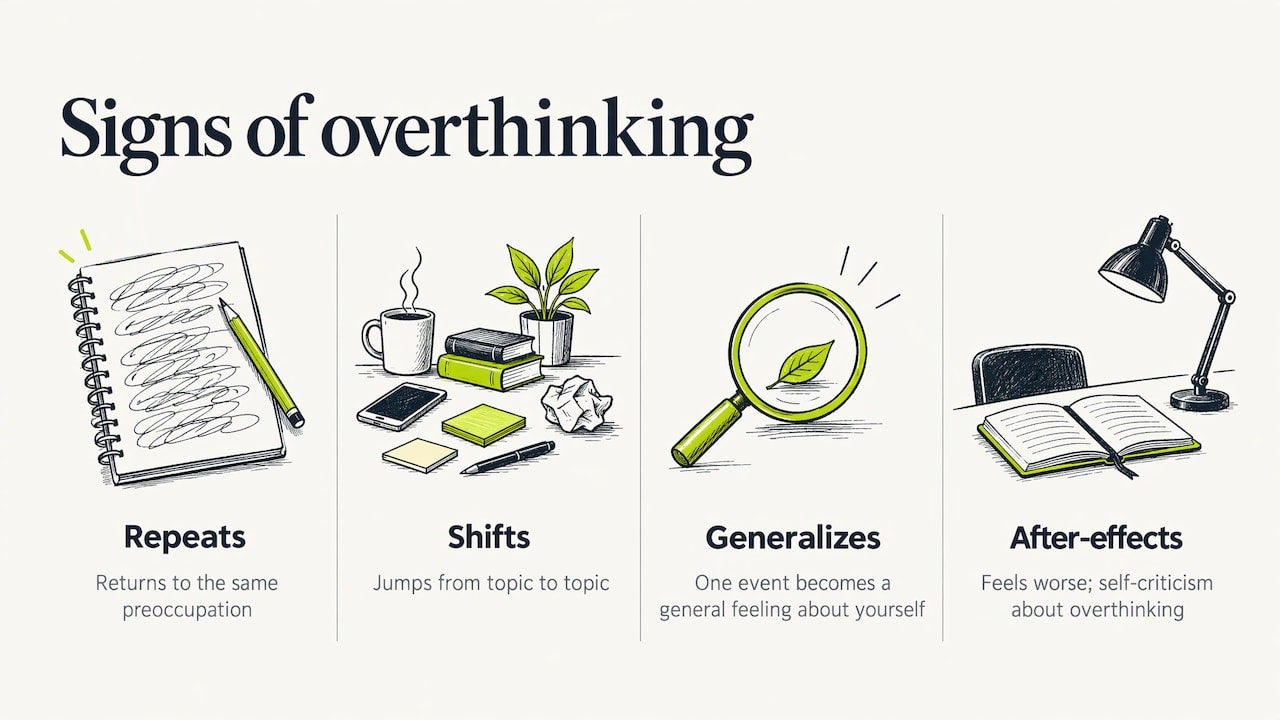
Verywell Mind lists common signs: being unable to think about anything else, being unable to relax, replaying situations, second-guessing decisions, fixating on things outside your control and imagining worst-case scenarios. Mental exhaustion is the one many people notice first.
A quick self-check: after ten minutes of thinking about this, do you have a decision, a plan or a clearer view? If not, you are probably ruminating rather than problem solving.
It helps to know why the habit sticks, because it changes how you respond.
The Ehring review explains that repetitive negative thinking is kept going by beliefs about the thinking itself, such as “this helps me cope” or “this is dangerous”, and by attempts to suppress thoughts, which tend to backfire. It often works as a way to avoid unpleasant feelings or action, and it becomes a mental habit triggered by cues like lying in bed or opening your inbox. Maladaptive rumination also tends to be abstract (“why does this always happen to me?”) rather than concrete (“what exactly happened, and what can I do?”).
The BPS psychologist adds the idea of an “expectation gap”: we fixate on the distance between where we feel we are and where we think we should be. Asking “why am I feeling like this?” is, in their words, the biggest mistake overthinkers make, because you can’t think your way out of a negative feeling any more than you can dig your way out of a hole.
Two practical conclusions follow:
When the loop is running, you need something quick. Pick one of these and try it for two to five minutes.
The American Psychological Association suggests breathing in for four counts, holding for four and breathing out for six, repeated ten times, because slower breathing lowers physiological arousal. A Psychology Today piece by Dianne Grande, Ph.D. reports that at least two minutes of deep breathing can trigger a relaxation response that is hard to reconcile with worry.
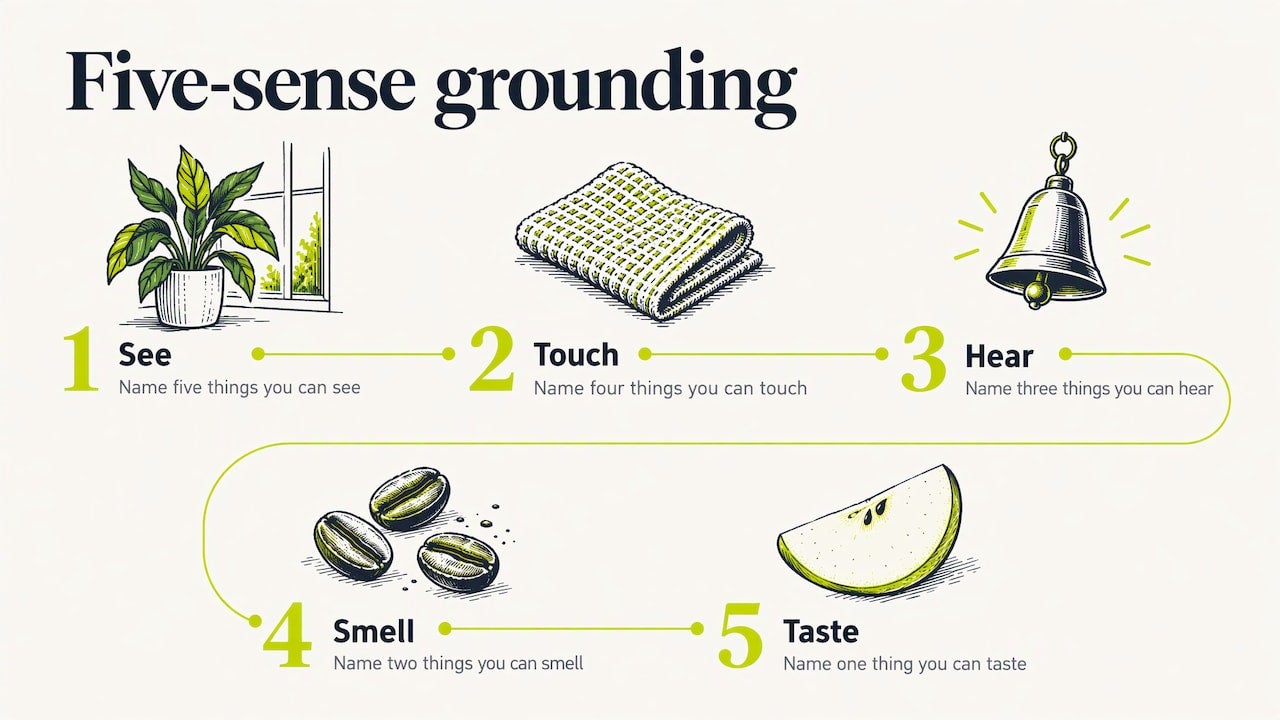
The Mental Health Commission of Canada’s anxiety tip sheet lists five-sense grounding among its in-the-moment actions. Name five things you can see, four you can touch, three you can hear, two you can smell and one you can taste. It pulls attention out of your head and into the room.
The APA also suggests counting backwards from 100 by threes. It works because it occupies the part of the brain that was busy spinning, with a task that is just hard enough to hold your attention.
Harvard Health points out that racing thoughts are often made worse by the worry about having them. Its advice is to acknowledge that they are just noise, something minds sometimes do. That removes the second layer of stress. It also recommends counting breaths up to ten and restarting, practised when you are calm so the skill is ready at night, and naming the pattern (“here I go again”) before deliberately switching to reading, music or a call with a friend.
Movement is one of the fastest interrupters. Harvard Health suggests short bursts such as ten jumping jacks or a five-minute walk. Grande’s article reports that as little as ten minutes of movement can lift mood and reduce anxiety, and that walking outdoors in wooded areas is linked with consistent improvement in emotional well-being.
Sometimes a thought needs a closer look rather than a distraction. Two structured approaches from reliable sources are easy to use.
Canada’s Centre for Addiction and Mental Health suggests that you pause when anxious and write down thoughts that begin with “What if…” or “I’m worried that…”. Then ask: is this worry helping me solve a problem, or keeping me stuck? Replace unbalanced thoughts with balanced ones. “I won’t be able to handle this” becomes “This may be difficult, but I have handled challenges before and can take it one step at a time.”
The Canadian Mental Health Association’s BC division offers five questions to test an anxious thought:
A worked example: you sent an email to your manager and now you are replaying it. The thought is “they think I’m incompetent.” Evidence for: none, they haven’t replied yet. All sides: they may be busy. Been here before: yes, last month, and the reply was a simple “thanks.” Chances: low. If it did happen: you could clarify in a short follow-up. Five questions, two minutes, and the thought has shrunk to its real size.
Harvard Health’s four-step process is easy to remember. Stop with a mental time-out. Breathe to ease tension. Reflect by asking whether the thought is true, what evidence you have and whether thinking this way helps. Choose how you will deal with the stressor.
A lot of overthinking is really unfinished planning. Your mind is trying to look after you, but it has picked the wrong strategy. Dr. Anna Katharina Schaffner, writing in Psychology Today Canada, says worrying and planning are two very different things. Worrying circles a problem. Planning ends in an action.
Try this at the end of the day:
Harvard Health also recommends scheduling 10 to 20 minutes of “worry time” at a fixed time of day. You write down thoughts and worst-case scenarios then, and when a worry appears at other times you tell it that it has an appointment later.
Work is one of the most common triggers, because the job is never fully done. Psychologist Guy Winch, speaking on a TED podcast in March 2026, says that if you are still thinking about work in the evening and on weekends, you aren’t getting a break, and that is where burnout happens. He recommends marking recovery time in your calendar, taking micro-breaks during the day and using a post-work transition ritual that engages several senses.
A simple version:
In-the-moment tools help, but the bigger gains come from lowering your baseline stress.
You don’t need all of this. Choose one tool from each of three groups and keep it for two weeks:
| Moment | What to try | How long |
|---|---|---|
| The loop starts | Count breaths, 4-4-6 breathing, or five-sense grounding | 2 to 5 minutes |
| The thought feels heavy | Five-question test or Stop, Breathe, Reflect, Choose | 5 minutes |
| End of the day | Write tomorrow’s actions, take a short walk, scheduled worry time | 10 to 20 minutes |
Creatives often find the loop shows up as self-editing before an idea is even on the page. Concrete steps help here too: set a timer, make something imperfect, and judge it later. Overthinkers also tend to be conscientious people, so treat the practice as training, not as another thing to get perfect.
Many people exploring emotional balance and mental clarity look at psilocybin products as one part of their routine, next to sleep, movement and breathwork. At Sero we make microdosing capsules, magic mushroom chocolate and magic mushroom tea, designed to support mood, focus and emotional balance, and we pair them with educational guides on responsible use. Our microdosing capsules are where most people begin, and you can read how they are meant to feel in Microdosing: Feeling the Effects.

If you want to learn before you decide, start with the guide to the best ways to take magic mushrooms in capsule form, or read about microdosing for depression and anxiety. Our Natural Anxiety Supplements for a Regulated Nervous System page covers other routine-building options.
In Canada, psilocybin remains a controlled substance under federal law, and legal medical access is limited to routes such as Health Canada’s Special Access Program, which requires a physician’s application, and approved clinical trials. Know the rules that apply to you before you buy or use anything.
This is for adults only. If you take prescription medication, are pregnant or breastfeeding, or have a personal or family history of serious mental illness, speak with your doctor or pharmacist first. Overthinking that comes with persistent low mood or panic is a reason to see a doctor, not to self-manage.
Overthinking is common, and it is not a medical condition by itself. But it can overlap with anxiety and depression. The Mental Health Commission of Canada’s Working Mind Pocket Card describes a four-stage continuum from healthy to ill. Nervousness and trouble sleeping belong to the “reacting” stage. Ongoing anxiety, pervasive sadness and withdrawal from others point to “injured”. Excessive anxiety, thoughts of suicide or being unable to do your duties signal “ill”, where the recommended action is to seek consultation and follow your health-care provider’s advice.
The CMHA BC advises talking to a doctor if anxiety is hard to manage on your own, since physical and mental health problems can both cause significant anxiety. In Canada, adults can text or call 988 at any time to reach a trained responder, and youth can text 686868. If you are in immediate danger, call 911.
Overthinking is usually a mental habit that formed because it feels like problem solving or protection. Research describes it as repetitive negative thinking, kept going by beliefs that it helps you cope and triggered by cues like quiet moments or stress. Stress, perfectionism and uncertainty make it more likely.
Slow your breathing for two minutes, using four counts in, four held and six out. Then switch to a task that needs your full attention, such as a short walk or counting backwards from 100 by threes. Both are supported by the APA and Harvard Health guidance above.
Separate worrying from planning. Write down tomorrow’s top tasks before you finish, then add a transition ritual like a walk or shower. Put recovery time in your calendar so your brain treats your evening as protected.
Not exactly. Overthinking is a thinking pattern, and anxiety is a broader condition that often includes it. If worry is constant, disrupts your sleep or work, or feels hard to control, talk to a doctor.
Adults can text or call 988 at any time, and youth can text 686868. CAMH and the Canadian Mental Health Association publish free self-help guides, and your family doctor can refer you to counselling.